AI Voice Agents
AI callers that qualify, route, and book without losing the handoff.
HMX maps the call flow, objection paths, CRM notes, booking rules, and escalation logic before choosing Vapi, Retell, Bland, Twilio, or another provider.
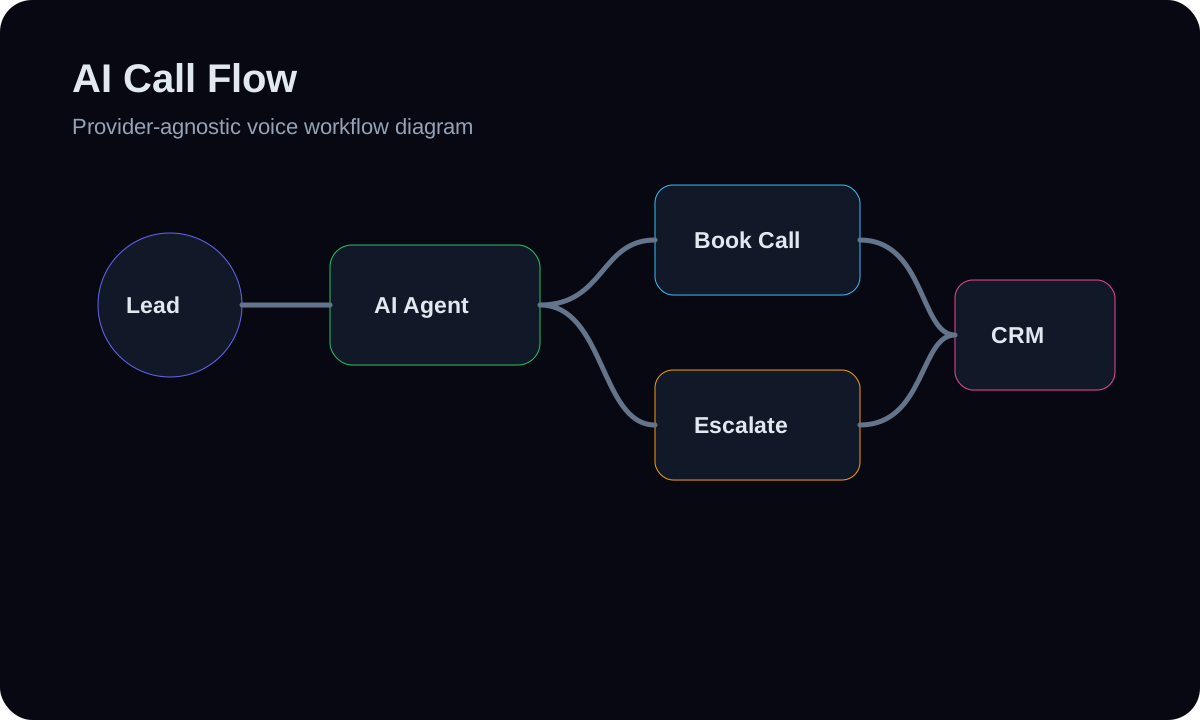
Qualification logic is written as a controlled system, not a vague prompt.
Bookings, notes, and outcomes sync back into the CRM for owner visibility.
Fallback paths handle objections, reschedules, failed calls, and human escalation.
Deliverables
Timeline guide
Small pilot
Usually 3-7 days for one controlled flow when tools, phone numbers, and calendar rules are ready.
Fuller rollout
Usually 2-4 weeks when multiple branches, owners, CRM fields, and compliance review steps are involved.
Build path
01
Map call intent
Define who should be called, what counts as qualified, and when a human should take over.
02
Build and test the agent
Test voice, latency, script branches, calendar checks, CRM notes, and failure cases.
03
Launch with guardrails
Start with measured volume, review transcripts, tune objections, and monitor booking quality.
Likely tools
Decision path
The first step is not picking software. It is mapping the current handoff, failure points, owner rules, fallback path, and proof boundary. The stack follows that map.
Before and after workflow
Lead qualification
Before
Human reps repeat the same first-call questions and manually summarize outcomes.
After
The agent asks only approved questions, records structured outcomes, and escalates uncertain calls.
Booking
Before
Qualified leads wait for manual calendar coordination.
After
Qualified leads can move into the right booking path with CRM notes attached.
Review
Before
Call quality is hard to audit because notes are inconsistent.
After
Transcripts, summaries, and edge cases are reviewed before volume increases.
Risk and fallback notes
What can break
Weak owner rules, unclear stop conditions, missing access, bad source data, or provider changes can make a workflow look complete while still failing in daily use.
Fallback / prevention
HMX maps the failure points, tests real branches with sample records, adds human review paths, and documents what should happen when automation confidence is low.
Responsible-use notes
This is implementation guidance, not legal advice. Call, SMS, consent, recording, and TCPA-style rules should be reviewed for the business, audience, location, and channel before launch.
AI voice flows should have consent-aware scripts, opt-out handling, human escalation, and transcript review where appropriate.
The agent should not make high-risk promises, pricing commitments, legal/medical/financial claims, or final decisions without a human-approved path.
Launches should start with controlled volume so failed calls, objections, and handoff quality can be reviewed before scaling.
FAQs
Can AI voice agents call cold leads?
Only if the business has a compliant basis and the call flow fits applicable consent, recording, and outreach rules. HMX scopes the technical guardrails but does not replace legal review.
Can the agent book appointments?
Yes, when qualification, calendar rules, fallback paths, and CRM updates are clear enough to test safely.
Will humans still review calls?
For launch and sensitive flows, yes. Human review is part of keeping the agent honest, useful, and bounded.
Which voice provider do you use?
The provider depends on call quality, latency, CRM handoff, phone setup, pricing, and the workflow's risk level.
AI Voice Agents
Want this scoped around your real workflow?
Send the core problem and desired build first. The deeper implementation details can come after the fit is clear.